
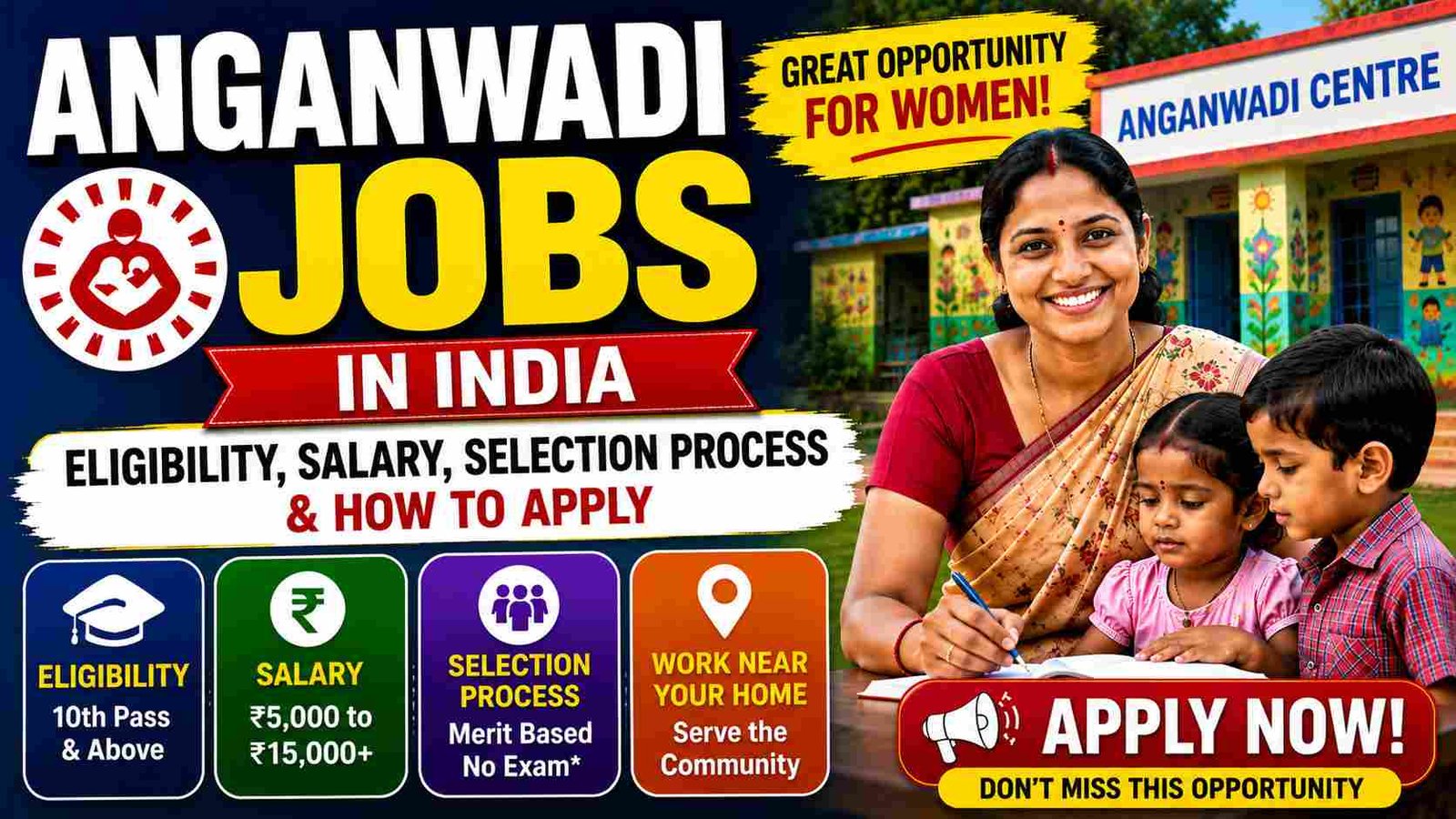
Anganwadi Jobs in India
Select Your Qualification
8th Pass➜ Check Your Eligibility 10th Pass➜ Check Your Eligibility 12th Pass ➜ Check Your Eligibility ITI / Diploma ➜ Check Your Eligibility Graduate Pass ➜ Check Your Eligibility Post Graduate ➜ Check Your EligibilityAnganwadi jobs are among the most popular government-related jobs in India, especially for women. These jobs provide an opportunity to serve children, pregnant women, and mothers while earning a regular income. Every year, different states release notifications for Anganwadi Worker, Anganwadi Helper, and Supervisor posts.
If you are looking for a stable job with simple eligibility requirements, Anganwadi recruitment can be a good option. In this article, you will learn about eligibility, salary, job roles, selection process, and the application process in simple language.
What Are Anganwadi Jobs?
Anganwadi Centres work under the Integrated Child Development Services (ICDS) program of the Government of India. Their main aim is to improve the health, nutrition, and education of children below six years of age and support pregnant and breastfeeding women.
The women working in these centres are called Anganwadi Workers and Anganwadi Helpers.
Types of Anganwadi Posts
1. Anganwadi Worker
An Anganwadi Worker manages the daily activities of the Anganwadi Centre. She takes care of children, maintains records, organizes health programs, and works with local health officials.
2. Anganwadi Helper
The Helper supports the Anganwadi Worker by preparing meals, cleaning the centre, helping children, and assisting in daily work.
3. Anganwadi Supervisor
A Supervisor checks the work of multiple Anganwadi Centres. This position usually requires higher educational qualifications and experience.
Eligibility for Anganwadi Jobs
The eligibility may vary slightly from one state to another.
Educational Qualification
- Anganwadi Helper: Usually 5th, 8th, or 10th pass.
- Anganwadi Worker: Usually 10th or 12th pass.
- Supervisor: Graduation may be required in many states.
Always check the official recruitment notification for your state before applying.
Age Limit
Most states follow these age limits:
- Minimum Age: 18 years
- Maximum Age: 35 to 45 years (depends on state rules)
Reserved category candidates usually receive age relaxation according to government norms.
Salary of Anganwadi Employees
The salary depends on the state government.
Approximate monthly earnings are:
- Anganwadi Helper: ₹5,000 to ₹10,000
- Anganwadi Worker: ₹8,000 to ₹15,000
- Anganwadi Supervisor: ₹20,000 to ₹40,000 or more
Some states also provide additional incentives and benefits.
Selection Process
The selection process is generally simple.
It may include:
- Merit based on educational qualification
- Document verification
- Local resident preference
- Interview (only in some states)
Most Anganwadi recruitments do not require a written examination.
Documents Required
Keep these documents ready while applying:
- Aadhaar Card
- Educational Certificates
- Passport-size Photograph
- Mobile Number
- Email ID
- Residence Certificate
- Caste Certificate (if applicable)
- Income Certificate (if required)
- Birth Certificate or Age Proof
How to Apply for Anganwadi Jobs
Follow these steps:
- Visit the official Women and Child Development (WCD) website of your state.
- Open the latest Anganwadi recruitment notification.
- Read the eligibility carefully.
- Fill in the application form.
- Upload the required documents.
- Submit the application before the last date.
- Save or print the application for future reference.
Some states also accept offline applications through local government offices.
Job Responsibilities
An Anganwadi Worker performs several important duties, including:
- Taking care of young children.
- Maintaining attendance records.
- Providing nutrition support.
- Organizing preschool education activities.
- Helping during vaccination programs.
- Supporting pregnant and breastfeeding women.
- Conducting awareness programs in villages.
Helpers assist in cooking, cleaning, and caring for children.
Benefits of Anganwadi Jobs
There are many advantages of working in an Anganwadi Centre.
- Opportunity to serve the community.
- Simple eligibility requirements.
- Regular monthly honorarium.
- Government-supported work environment.
- Local job opportunities for women.
- Work close to home in many cases.
- Experience in child care and community service.
Tips Before Applying
- Read the official notification carefully.
- Ensure your documents are valid.
- Apply before the deadline.
- Keep copies of all certificates.
- Check the official website regularly for updates.
Frequently Asked Questions (FAQs)
1. Who can apply for Anganwadi jobs?
Women who meet the educational qualification, age limit, and local residency requirements mentioned in the official notification can apply.
2. Is there a written exam for Anganwadi recruitment?
In many states, recruitment is based on merit and document verification. Some states may conduct additional selection stages if required.
3. What is the salary of an Anganwadi Worker?
The monthly honorarium generally ranges between ₹8,000 and ₹15,000, depending on the state government.
4. Can 10th pass candidates apply?
Yes. Many states allow 10th pass candidates to apply for Anganwadi Worker or Helper posts, depending on the recruitment rules.
5. Where can I find the latest Anganwadi vacancies?
You can check the official Women and Child Development (WCD) department website of your state for the latest notifications.
6. Is Anganwadi a permanent government job?
Most Anganwadi Workers and Helpers receive an honorarium under government schemes. Their service conditions vary by state and are governed by the respective state government rules.
7. What documents are required for the application?
Applicants usually need educational certificates, Aadhaar Card, residence proof, age proof, passport-size photographs, and category certificates if applicable.
8. Can candidates from all states apply?
Recruitment is generally state-specific, and many vacancies give preference to local residents. Applicants should check the eligibility criteria mentioned in their state’s official notification.