
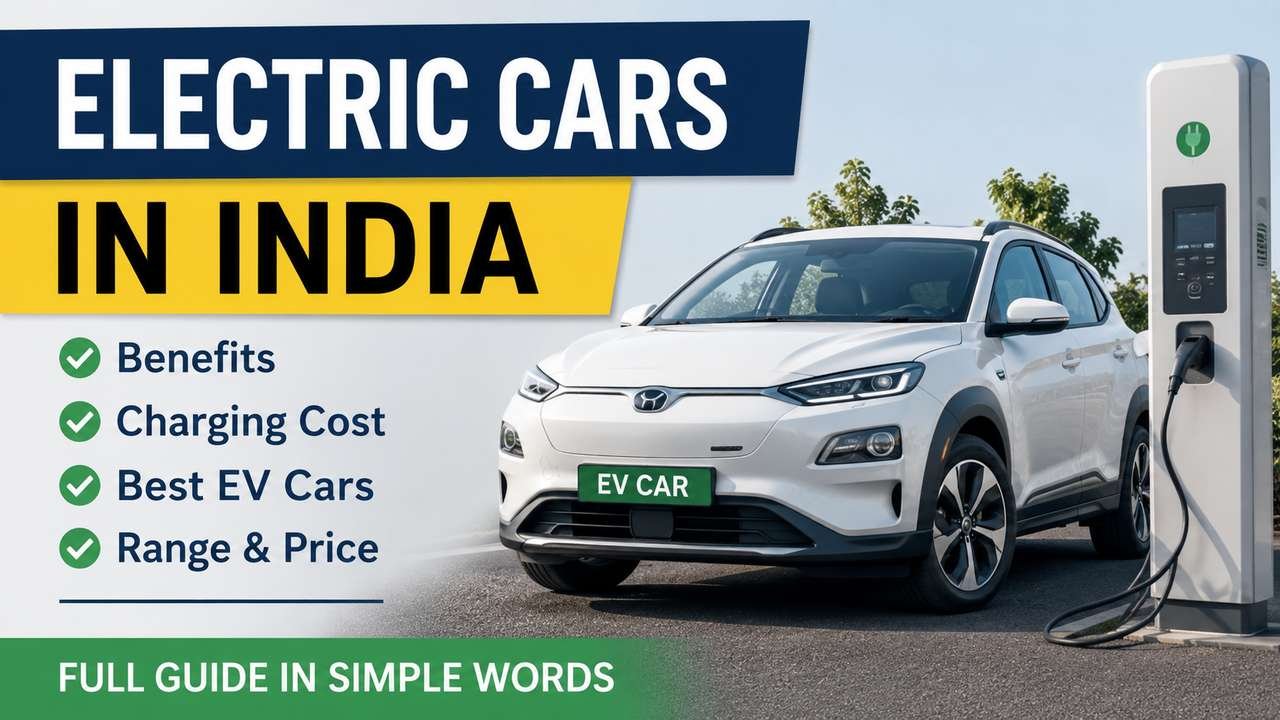
Electric cars are becoming popular in India. Many people are now looking for electric vehicles because they can help reduce fuel costs and pollution. With more companies launching new electric cars, buyers have many options in different price ranges.
In this article, we will explain what EV cars are, how they work, their benefits, charging options, running costs and some popular electric cars available in India.
What Is an EV Car?
An EV car, or electric vehicle, is a car that runs mainly on electricity instead of petrol or diesel.
An electric car uses a battery to store electricity. This electricity powers an electric motor, which moves the car. Unlike traditional petrol and diesel cars, a fully electric car does not need an internal combustion engine.
EV cars can be charged at home or at public charging stations.
How Do Electric Cars Work?
Electric cars use a rechargeable battery pack. When you charge the car, electricity is stored in the battery.
When you start driving, the battery sends electricity to the electric motor. The motor turns the wheels and moves the vehicle.
Most electric cars also use regenerative braking. During braking or slowing down, some energy is recovered and sent back to the battery.
Why Are EV Cars Becoming Popular in India?
There are several reasons behind the growing popularity of electric cars in India.
Lower Running Cost
Electricity can cost less than petrol or diesel for every kilometre driven. This can make an EV attractive for people who drive regularly.
Less Maintenance
Electric cars generally have fewer moving mechanical parts than petrol and diesel cars. They do not require engine oil changes and have fewer engine-related components.
However, tyres, brakes, suspension and other components still require regular maintenance.
Environment Friendly
Fully electric cars do not produce exhaust emissions while driving. This can help reduce pollution from road transport, especially when electricity is generated from cleaner sources.
Smooth Driving
Electric motors can deliver power quickly. As a result, many EVs offer smooth acceleration and quiet driving.
Best EV Cars in India
The Indian electric car market has options from several manufacturers. Depending on your budget and requirements, you can consider models from companies such as Tata Motors, MG Motor, Mahindra, Hyundai and other manufacturers.
Some popular EV models include:
| Electric Car | Key Point |
|---|---|
| Tata Nexon EV | Popular electric SUV |
| Tata Punch EV | Compact electric SUV |
| Tata Tiago EV | Affordable electric hatchback |
| MG Windsor EV | Practical electric vehicle |
| Mahindra XUV400 EV | Electric SUV |
| Hyundai Creta Electric | Electric SUV option |
| MG ZS EV | Premium electric SUV |
Prices and variants can change frequently, so buyers should check the latest price from the manufacturer’s official website or local dealer before purchasing.
EV Car Price in India
The price of an electric car depends on its model, battery capacity, variant and features.
Affordable EVs are available for buyers looking for city travel, while premium electric cars can cost considerably more.
The initial purchase price of an EV can be higher than a similar petrol car. However, lower running and maintenance costs may help reduce the total cost of ownership over several years.
Electric Car Range
Range is one of the most important factors when buying an EV.
The range tells you approximately how far the car can travel on a full battery charge.
For example, a car with a claimed range of 300 km may be suitable for daily city travel as well as occasional longer trips. However, actual range can be different from the claimed figure.
Driving speed, traffic, air conditioning, road conditions, temperature, vehicle load and driving style can affect EV range.
How Much Does It Cost to Charge an EV?
The cost of charging an electric car depends on the battery size and electricity tariff.
For example, if an EV has a usable battery capacity of 30 kWh and electricity costs ₹8 per unit, a simple calculation would be:
30 × ₹8 = ₹240
So, charging the battery could cost around ₹240 under those assumptions.
Actual charging cost can be different because of charging losses, electricity tariffs and the battery’s charging condition.
Home Charging for EV Cars
Many EV owners charge their cars at home.
A home charging setup can be convenient because the vehicle can be plugged in after returning home and left to charge overnight.
Before installing a charger, the electrical connection and installation requirements should be checked. Some vehicles may support faster AC charging with a suitable wall-mounted charger.
Public EV Charging Stations
Public charging stations are becoming more common in Indian cities and along some highways.
They can be useful when travelling long distances.
However, charging availability can vary by location. Before a long journey, EV owners should check the availability, charger type and compatibility at charging stations along the route.
Fast Charging
Fast charging can charge an EV much quicker than a standard home charger.
The actual charging speed depends on the vehicle, battery temperature, battery state of charge and charging station capacity.
Fast charging is particularly useful during highway trips when drivers want to spend less time waiting.
Advantages of EV Cars
Electric cars offer several benefits.
- Lower running cost
- No petrol or diesel requirement
- Quiet driving experience
- Fewer engine-related maintenance requirements
- Regenerative braking
- No tailpipe emissions while driving
- Convenient home charging
- Useful for daily city travel
Disadvantages of EV Cars
EVs also have some limitations.
Higher Initial Price
Some electric cars have a higher purchase price compared with petrol or CNG alternatives.
Charging Time
Depending on the charger, charging an EV can take considerably longer than filling a petrol or diesel car.
Charging Infrastructure
Charging stations are increasing, but availability may still be limited in some locations.
Battery Replacement Cost
The battery is one of the most expensive components of an EV. Battery life depends on usage, charging practices, temperature and other factors.
EV Battery Life
Modern electric car batteries are designed to last for many years. However, battery capacity gradually decreases over time.
Manufacturers generally provide battery warranties subject to specific terms and conditions.
When buying an EV, customers should check the battery warranty, coverage period and conditions carefully.
Are EV Cars Good for Daily Use?
For many city users, EV cars can be a good option.
If your daily driving distance is predictable and you have convenient access to charging, an electric car can be comfortable and economical to operate.
People who frequently travel long distances to areas with limited charging facilities may need to plan their journeys more carefully.
EV Cars vs Petrol Cars
| Feature | EV Car | Petrol Car |
|---|---|---|
| Main energy source | Electricity | Petrol |
| Tailpipe emissions | No | Yes |
| Running cost | Generally lower | Generally higher |
| Engine oil | Not required for electric motor | Required |
| Refuelling/charging | Charging required | Fuel station |
| Home energy option | Yes | No |
| Long-distance planning | Charging planning may be needed | Usually easier |
Government Support for Electric Vehicles
The Indian government and state governments have introduced different policies and incentives from time to time to encourage electric mobility.
Benefits can vary depending on the vehicle, state, purchase date and applicable rules.
Therefore, buyers should check the latest government notification and state-level EV policy before purchasing an electric car.
Things to Check Before Buying an EV
Before buying an electric car, consider the following points:
- Your daily driving distance
- Claimed and real-world range
- Battery capacity
- Home charging availability
- Public charging network
- Charging speed
- Battery warranty
- Vehicle warranty
- Service network
- On-road price
- Insurance cost
- Resale value
Is Buying an EV Car Worth It?
An electric car can be worth considering if you regularly drive in the city and have easy access to charging.
The biggest advantage is usually the lower running cost. However, buyers should compare the complete cost of ownership rather than looking only at the purchase price.
For people who drive very little or frequently travel long distances through areas with limited charging infrastructure, a petrol, CNG or hybrid vehicle may sometimes be more convenient.
Frequently Asked Questions
Which is the best EV car in India?
There is no single best EV car for everyone. The right model depends on your budget, range requirement, charging access, space requirements and driving pattern.
Are electric cars cheaper to run?
Electric cars can have a lower running cost per kilometre than petrol or diesel cars, depending on electricity and fuel prices and the vehicle’s efficiency.
Can an EV car be charged at home?
Yes. Many electric cars can be charged at home using suitable charging equipment.
How long does an EV battery last?
Battery life varies by model and usage. Buyers should check the manufacturer’s battery warranty and terms before purchasing.
Are EV cars suitable for long-distance travel?
Yes, but long-distance EV travel requires charging planning. Drivers should check charging stations along their route before starting the journey.
Do EV cars need maintenance?
Yes. EVs still require maintenance for tyres, brakes, suspension, air conditioning and other components, although they generally have fewer engine-related maintenance requirements.
Conclusion
EV cars are changing the way people travel in India. Lower running costs, quiet driving and convenient home charging are some of the main reasons people are considering electric vehicles.
However, an EV is not automatically the best choice for every buyer. Before purchasing, check the car’s range, charging time, battery warranty, service network and total ownership cost.
With charging infrastructure continuing to develop and more electric models entering the market, EV cars are likely to become an increasingly important part of India’s automobile market.